


Scientists of Kanazawa University, Vietnam National Museum of Nature, Shanghai Natural History Museum, Vietnam Institute of Geosciences and Mineral Resources Published they describe the first discovery of two living ostracods from the Japanese archipelago, Sinocytheropteron ignobile and Sinocytheridea impressa, which are typically continental faunal elements from China, during their research on the distribution of ostracod assemblages in the Ariake and Yatsushiro Seas in southwest Japan. The (palaeo-) biogeographical data from recent research and fossil records indicate that S. ignobile and S. impressa migrated through land bridges during past decreases in sea levels.
They also discovered Xestoleberis ryukyuensis, which has been reported from the Ryukyu Islands; its discovery in their study area indicates the current northernmost distribution of the species and suggests that it migrated from the Ryukyu Islands to the study area by using the Tsushima Warm Current, a branch of the main Kuroshio Current. This evidence suggests that the migration of shallow-marine ostracods between the continents and their adjacent islands affect not only global oceanic current but also global decreases in sea levels and the (palaeo-) geography of adjacent seas. Thus, ostracods living within the continental coasts provide powerful evidence for reconstructing the connection be-tween the continent and its adjacent islands.
Source: MSc. Doan Đinh Hung – Department Geology
Processing: Department of Communication and Community Education
Article name: Recent ostracod distribution in western Kyushu, Japan, related to the migration of Chinese continental faunal elements, 2019. Gengo Tanakaa,g,⁎ , Yasuhisa Henmib , Tatsuya Masudac , Hiroshi Moriwakid , Toshifumi Komatsue , Baochun Zhouf , Takumi Maekawab , Sota Niiyamah , Phong D. Nguyeni , Hung D. Doanj , Noriyuki Ikeyak. Marine Micropaleontology 146: 1-38.
Article details: https://www.sciencedirect.com/science/article/pii/S0377839818300707

Fig. 1. Locations of the study areas. Open circles with a number indicate the sediment sample stations. Notes: KC = Kuroshio Current, TWC = Tsushima Warm Current, YC = Yatsushiro City, MC = Minamata City, IC = Izumi City, Is. = Island, Iss = Islands, St. = Station, AMS = Aitsu Marine Station of Kumamoto University.

Fig. 3. Geographical distribution of biofacies A, B, C, and D. Sample station (St.) 1 corresponds to biofacies D.
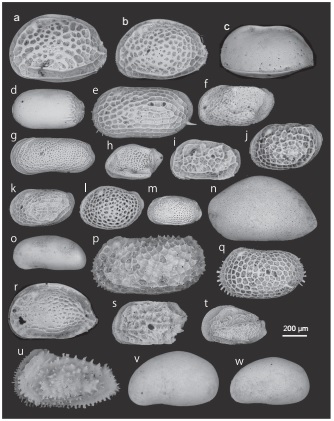
Fig. 4. Scanning electron micrographs of the characteristic species of biofacies A, B, C, and D. All specimens are shown in external left lateral view. Except for (q) which is an A-1 instar, all specimens are adults. (a) Aurila spiniferaSchornikov and Tsareva, 1995, St. 9, GCM-RS 521; (b) Aurila cymba (Brady, 1869), 1968, St. 1, GCM-RS 522; (c) Amphileberis nipponica (Yajima, 1978), St. 8, GCM-RS 523; (d) Ambtonia tsukuiHu and Tao, 2008, St. 8, GCM-RS 524; (e) Bicornucythere bisanensis (Okubo, 1975), St. 32, GCM-RS 525; (f) Bythoceratina cf. hanaiiIshizaki, 1968, St. 9, GCM-RS 526; (g) Cytheromorpha acupunctata (Brady, 1880), St. 32, GCM-RS 527; (h) Cytheropteron miurenseHanai, 1957c, St. 9, GCM-RS 528; (i) Callistocythere undulatifacialisHanai, 1957a, St. 4, GCM-RS 529; (j) L. tosaensisIshizaki, 1968, St. 32, GCM-RS 530; (k) Loxoconcha uranouchiensisIshizaki, 1968, St. 29, GCM-RS 531; (l) Loxoconcha vivaIshizaki, 1968, St. 8, GCM-RS 532; (m) Nipponocythere bicarinata (Brady, 1880), St. 7, GCM-RS 533; (n) Neonesidea oligodentata (Kajiyama, 1913), St. 9, GCM-RS 534; (o) Parakrithella pseudadonta (Hanai, 1959a), St. 1, GCM-RS 535; (p) Pistocythereis bradyformis (Ishizaki, 1968), St. 7, GCM-RS 536; (q) Pistocythereis bradyi (Ishizaki, 1968), St. 29, GCM-RS 537; (r) Pseudoaurila japonica (Ishizaki, 1968), St. 29, GCM-RS 538; (s) Schizocythere kishinouyei (Kajiyama, 1913), St. 10, GCM-RS 539; (t) Spinileberis quadriaculeata (Brady, 1880), St. 32, GCM-RS 540; (u) Trachyleberis scabrocuneata (Brady, 1880), St. 32, GCM-RS 541; (v) Xestoleberis hanaiiIshizaki, 1968, St. 1, GCM-RS 542; (w) Xestoleberis ryukyuensisSato and Kamiya, 2007, St. 1, GCM-RS 543.

Fig. 5. Geographic distributions of Sinocytheropteron ignobile (Guan, 1978) in Guan et al. (1978) around the eastern margin of Eurasia. Scanning electron microscopy (SEM) images in the upper left show a female specimen (upper) and juvenile with attached appendages (lower) from St. 10 of the Ariake Sea (GCM-RS 545). Extant specimens: 1. Ariake Sea (this study). Empty-valved specimens: 2. Southwestern slope of the Ulleung Basin, Korea (Cheong et al., 1986); 3. Hyuga-nada and off Tanega-shima Island (Zhou, 1995); 4. East China Sea (Zhao, 2000); 5. South China Sea (Zheng et al., 1994; Zhao, 2000). Fossil specimens: 6. Upper Pliocene Soguipo Formation (Lee and Paik, 1992); 7. Quaternary sample from off Dongtai and Sheyang (Hou et al., 1982; Liu, 1989); 8. Middle Pliocene Aka Formation (Tanaka and Nomura, 2009); 9. Pleistocene Tungshiao Formation (Hu, 1986; Hu and Tao, 2008); 10. Pliocene Cholan Formation (Hu, 1976); 11. Pliocene Muchenkei Formation (Hu and Tao, 2008); 12. Pliocene Wanglougang and Foluo formations (Guan et al., 1978; Gou et al., 1981, 1983).

Fig. 6. Triangular diagram plotted the percent of each coastal and estuarine species from east China, species common among east China and the Ariake and Yatsushiro Seas, and estuarine species from the Ariake and Yatsushiro Seas.
Notes: The East China data (〇) are from Wang et al. (1988). Other symbols are from the Ariake and Yatsushiro Seas (Biofacies A, ■; Biofacies B, ▲; Biofacies C, ◆; Biofacies D,×; St. 34, +).
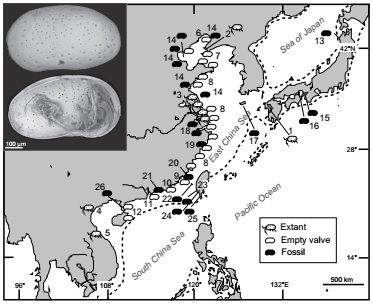
Fig. 7. Geographic distributions of Sinocytheridea impressa (Brady, 1869) around the eastern margin of Eurasia. Scanning electron microscopy (SEM) images in the upper left show a female specimen with appendages from sample station (St.) 34 in the Yatsushiro Sea (GCM-RS 544). Extant specimens: 1. Yatsushiro Sea (this study); 2. Bohai Sea (Tanaka personal observation); 3. Yellow Sea and East China Sea (Wang et al., 1985c); 4. Ha Long (Tanaka et al., 2009); 5. Dong Hoi (Tanaka personal observation). Empty-valved specimens: 6. Bohai Sea (Zhao and Wang, 1988); 7. Yellow Sea (Wang et al., 1985a,b; Zhao and Wang, 1988); 8. East China Sea (Wang and Zhao, 1985; Zhao and Wang, 1988); 9. Pratas Islands (Cai, 1982; Hu and Tao, 2008); 10. Quemoy Island (Hu and Tao, 2008) and Shantou (Zhao and Wang, 1988; Zheng et al., 1994); 11. Hong Kong (Brady, 1869; Whatley and Zhao, 1987; Zhao and Wang, 1988; Zheng et al., 1994; Hong et al., 2017); 12. Leizhou Peninsula and Hainan Island (Zhao and Wang, 1988). Fossil specimens: 13. the Upper Pliocene Sasaoka Formation (Yamada et al., 2002); 14. the Upper Pleistocene and Holocene borehole core samples from the coast of the East China Sea (Wang et al., 1985d); 15. The Middle Pleistocene borehole core samples (Ishizaki, 1990); 16. The Middle Pleistocene Takatsukayama Member, Meimi Formation (Irizuki et al., 2005); 17. The Plio-Pleistocene Sogwipo Formation (Lee and Paik, 1992); 18. Quaternary borehole core sample of Tianjin (Huang, 1985); 19. Quaternary sample from of Dongtai and Sheyang (Hou et al., 1982); 20. Fujian (Zheng, 1987); 21. Pleistocene to Holocene borehole cores from Hong Kong (Cao, 1998); 22. The Upper Pliocene Xiyuping Sandstone (Hu and Tao, 2008); 23. The Pleistocene Shoushan Formation (Hu and Tao, 2008); 24. The Upper Pleistocene Soukou Formation (Hu and Tao, 2008); 25. The Middle Pleistocene Liushuang Formation (Hu and Yeh, 1978); 26. The Pliocene Wanglougang Formation (Guan et al., 1978; Gou et al., 1983; Hou and Gou, 2007). The coastline of the Last Glacial Maximum (−130 m) is indicated by the dashed line. (For interpretation of the references to colour in this figure legend, the reader is referred to the web version of this article.)