


With increasing pressure from wildlife trade, conservation efforts must balance deficiencies in distribution data for species (the Wallacean shortfall) with the risk of increasing accessibility of locality for collectors. The Golden Kaiser-I-Hind (Teinopalpus aureus Mell) is an iconic butterfly restricted to Southeast Asia, popular in trade markets but lacking in ecological and conservation information. We compiled occurrence records and used them to assess multiple threats of T. aureus distribution-wide and at the national level. Results of species distribution models suggest that suitable habitats of T. aureus are montane forests in mid to high elevations in Southern China, Laos and Vietnam. However, habitat networks for the species are poorly connected, with some portions of its distribution experiencing intensive deforestation and threatened by climate change. The trade assessment results showed specimens of T. aureus were available for sale with high prices, indicating potential pressure from trade markets. We also found different conservation statuses and efforts to protect T. aureus across countries; the species is under strict protection in China, moderate protection in Vietnam and has no protection in Laos. Both recorded locations and projected distribution in the three countries were poorly covered by protected areas.
These results together demonstrate the importance of distribution data in conservation management of threatened species while highlighting trade-offs inherent in not making location information widely available when trade pressure is present. Finally, we strongly encourage cross-border cooperation in sharing ecological information for consistent conservation management of species under multiple threats from habitat loss, climate change and illegal wildlife trade.
Some research results of the species:
Current distribution of T. aureus
Based on the climate conditions among the locations where T. aureus has been recorded, we found that the butterfly prefers to inhabit relatively cool and humid mid-high elevations in Southern China, Laos, and Vietnam. The air temperatures extracted from occurrence records ranged from 12.96 °C to 20.71 °C, with an annual mean air temperature of 16.84 °C and monthly mean precipitation of 149.10 mm. The climatic conditions during the butterfly active period were slightly warmer and more humid compared with that of the whole year. Recorded elevation ranged from 439.42 m to 1905.85 m with 1010.84 m as the mean.
The habitat suitability map from SDMs showed that southern China may provide the largest suitable areas for T. aureus and that some areas in northern Laos and Vietnam are also suitable (Fig. 1). The predicted current suitable habitats are, however, exhibiting high levels of fragmentation and little connectivity over the entire suitable distribution (Fig. 1). The projected average elevation of the current suitable habitat distribution ranges from 813.75 m to 1280.27 m in each country with 1085.15 m as the mean across countries.
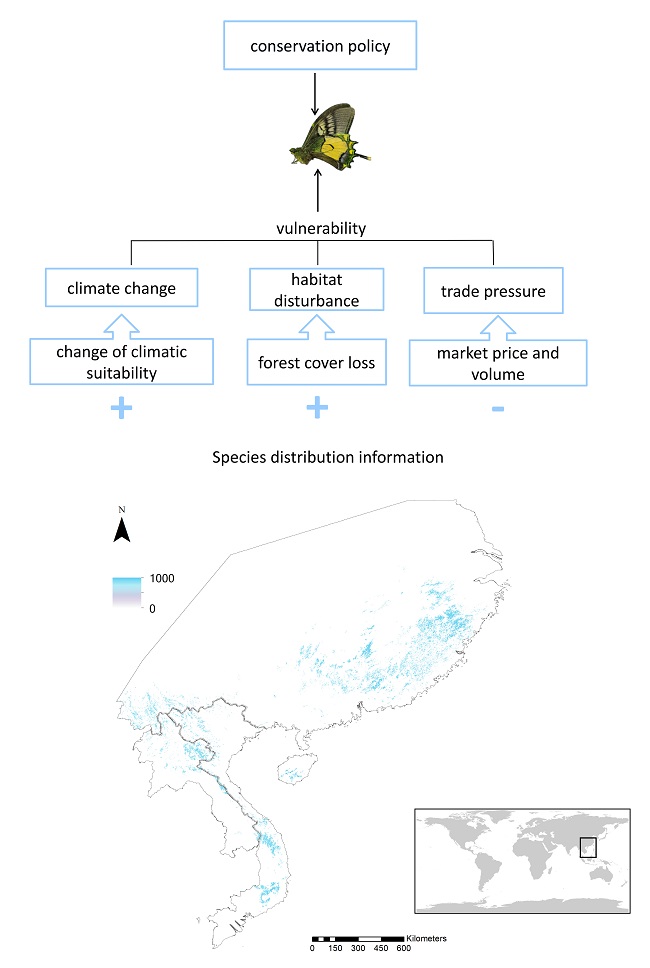
Fig. 1. Framework of assessing the vulnerability of T. aureus (the plus and minus symbol indicate the potential positive and negative effects of releasing species distribution information for understanding and mitigating the three proposed threats) together with estimated suitable habitat across regions where T. aureus has been recorded (blue end indicates higher suitability while white end indicates lower suitability).
Projected changes in distribution
With climate change, habitat suitability within most of the current estimated distribution will severely decrease as predicted by the three GCM models for both RCP 2.6 and RCP 8.5 scenarios in 2070 (Fig.2). Under full dispersal scenarios (assuming T. aureus can colonize any location without biological limitations), the species will need to shift 140.21–554.34 m upwards to track its suitable habitat with appropriate climate and forest types under two RCP scenarios in different countries. Under non-dispersal scenarios, there would be a loss of 76.93% on average ranging between 53.59% and 96.87% (depending on the scenario) of current suitable habitat within the three countries under different climate change scenarios.
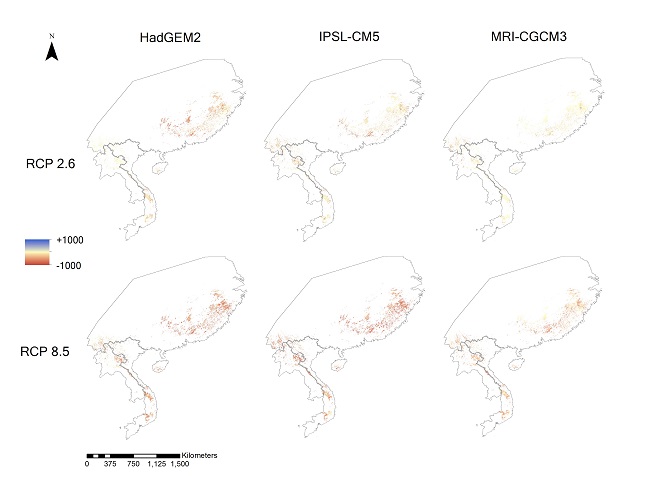
Fig. 2. Predicted change of habitat suitability with different climate change scenarios by different GCM models in 2070. Blue suggests increase in habitat suitability while red suggests decrease in habitat suitability.
Forest loss in recent decades experienced by T. aureus
The level of forest loss varied across countries. The most severe forest loss experienced by the species occurred in Laos, where about 8.99% of the projected suitable distribution of T. aureus experienced forest cover loss from 2000 to 2015, and the areas of forest loss seem to be most severe and intense in northern Laos near the border with Vietnam (Fig. 3). Similarly, 8.65% of its distribution in China showed forest cover loss, while the loss pattern seems to be more evenly distributed across the projected distribution of T. aureus. In Vietnam, 8.28% of the projected distribution showed forest cover loss, mostly in southern Vietnam (Fig. 3).
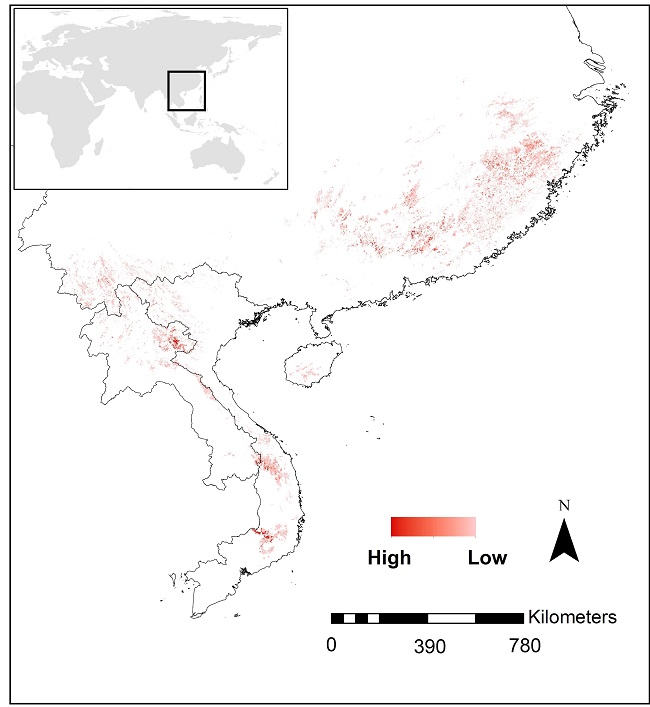
Fig. 3.Observed forest cover loss from 2000 to 2015 within the projected current distribution of T. aureus. Darker red color indicates higher intensity of forest cover loss.
Name of the paper: Xinga S., Aua T.F., Dufoura C. P., Chenga W., Yuana L. F., Jiac F. , Vu V. L., Wange M., Bonebrake C. T. 2019. Conservation of data deficient species under multiple threats: Lessons from an iconic tropical butterfly (Teinopalpus aureus). Biological Conservation 234, 154-164.
It can be found at https://www.sciencedirect.com/science/article/pii/S0006320719300138
Vu Van Lien
The Vietnam National Museum of Nature, VAST